
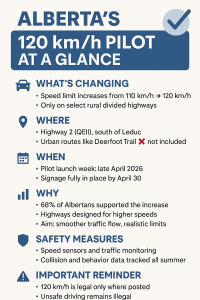
What Drivers Need to Know Starting April 30, 2026
Beginning Wednesday, April 30, 2026, the Government of Alberta is implementing a pilot project increasing speed limits from 110 km/h to 120 km/h on select rural divided highways.
According to official provincial materials and public engagement summaries published by Government of Alberta, this initiative is a controlled, data-driven trial—not a blanket increase—intended to assess whether Alberta’s highway infrastructure can safely support higher operating speeds. Media outlets including CBC News and Global News have reported that the province will closely monitor safety outcomes before making any permanent changes.
Why Alberta Is Increasing Speed Limits
The move toward 120 km/h follows a province-wide public engagement process conducted by the Government of Alberta.
Key findings reported in provincial summaries and covered by media:
Approximately two-thirds of respondents supported increasing speed limits on divided highways
Alberta Transportation indicated that many major corridors—particularly Highway 2 (QEII)—are engineered to safely accommodate higher speeds
Officials cited advancements in vehicle safety systems, road design, and traffic engineering standards as justification for revisiting legacy limits
Public statements from provincial transportation officials emphasize that:
Speed limits should reflect road design, driver behaviour, and modern safety standards, not solely historical policy.
Where the Changes Will Apply
The pilot applies only to designated rural divided highways—not urban roadways or undivided highways.
Based on government communications and media reporting (CBC, Global News), candidate corridors include:
Sections of Highway 2 (QEII) south of Leduc
Portions of Highway 16 (Yellowhead Highway) near Edmonton
Segments of Highway 1 (Trans-Canada Highway)
Parts of Highway 63
These highways typically meet strict criteria:
Multiple lanes in each direction
Physical median separation
High-capacity design and controlled access
The province has made it clear:
Only highways that meet specific engineering and safety thresholds will be included.
How the Pilot Project Will Work
This initiative is explicitly framed as a pilot program, not a permanent policy change.
According to the Government of Alberta and corroborated by media reporting:
The province will monitor:
Collision frequency and severity
Traffic flow and travel times
Driver behaviour patterns
Enforcement data and compliance trends
The stated objective is to:
Collect empirical, real-world data to determine whether a 120 km/h limit can be implemented safely on a long-term basis.
Potential Benefits
Supporters—including provincial officials and industry stakeholders—point to several anticipated benefits:
1. Reduced Travel Times
A 10 km/h increase can meaningfully reduce travel time on long-distance routes such as Edmonton–Calgary.
2. Alignment with Actual Driving Behaviour
Government engagement materials acknowledge that many drivers already travel above 110 km/h. A higher posted limit may:
Reduce speed differentials
Improve traffic flow consistency
3. Economic Efficiency
Faster movement along key trade corridors may:
Improve logistics efficiency
Strengthen regional economic connectivity
Safety Concerns and Criticism
Not all stakeholders support the increase.
Concerns raised by safety advocates and reported by CBC and Global News include:
Higher speeds increase collision severity
Potential strain on emergency response systems
Risk of driver overconfidence, particularly in adverse conditions
There is also precedent in other jurisdictions where:
Speed limits were increased and later reduced following safety concerns
Critics emphasize that:
Road safety is influenced as much by human behaviour as by engineering design.
Legal and Enforcement Implications
From a legal standpoint, this change does not reduce driver obligations.
The Traffic Safety Act continues to govern all driving conduct.
Key principles:
Speed limits are maximums—not targets
Drivers must operate with due care and attention
Speed must be adjusted based on:
Weather
Visibility
Traffic conditions
Road hazards
Enforcement
Law enforcement—including RCMP and provincial agencies—will continue to monitor:
Speeds exceeding 120 km/h
Aggressive driving (tailgating, unsafe lane changes)
Failure to adjust speed for conditions
Government and media sources indicate that enforcement activity may increase during the pilot to assess compliance.
What Drivers Should Keep in Mind
If you are driving after April 30, 2026:
Watch for posted signage — only designated sections will be 120 km/h
Do not assume all highways are affected
Adjust speed for weather and road conditions
Expect active enforcement during the pilot phase
The Bottom Line
Alberta’s 120 km/h pilot represents a significant shift in transportation policy—one grounded in public engagement, engineering standards, and empirical testing.
However, its success is not guaranteed.
As emphasized by both the Government of Alberta and major media coverage:
The pilot will ultimately determine whether higher speeds can be implemented without compromising public safety.
Client Advisory
Legal Implications for Drivers
Effective: April 30, 2026
Overview
As confirmed by the Government of Alberta and widely reported by CBC News and Global News, select highways will now permit speeds up to 120 km/h.
This does not reduce legal liability.
Key Legal Principle: Maximum Speed ≠ Safe Speed
Under the Traffic Safety Act:
A posted limit is a legal ceiling
Drivers must still act reasonably in the circumstances
Driving at 120 km/h may still result in:
Careless driving charges
Findings of negligence
Contributory liability in civil claims
Collision Liability Exposure
Higher speeds increase:
Severity of injuries and damages
Litigation risk
Potential quantum of damages
Courts will assess:
Whether your driving was reasonable, not merely compliant with signage.
Insurance Risk
Insurers may:
Scrutinize speed in collision investigations
Deny or limit coverage in cases of reckless conduct
Increase premiums following high-speed incidents
Practical Risk Management
To reduce exposure:
Treat 120 km/h as a maximum under ideal conditions only
Reduce speed in adverse conditions
Maintain safe following distances
Avoid aggressive driving behaviour
Our Position
At Triple A Legal Services:
The increase to 120 km/h raises the legal and financial stakes for drivers.
Failure to adjust behaviour accordingly may result in:
Traffic charges
Civil liability
Insurance complications
Need Representation?
If you are facing a traffic offence, civil claim, or enforcement matter:
Triple A Legal Services
Email: contact@triplealegalservices.ca
Phone: (780) 665-6457
Services include:
Traffic and provincial offence defence
Civil liability and Small Claims matters
Enforcement and payment hearing strategy
Disclaimer: This material is for general information only and does not constitute legal advice. Each case depends on its specific facts and applicable law.